
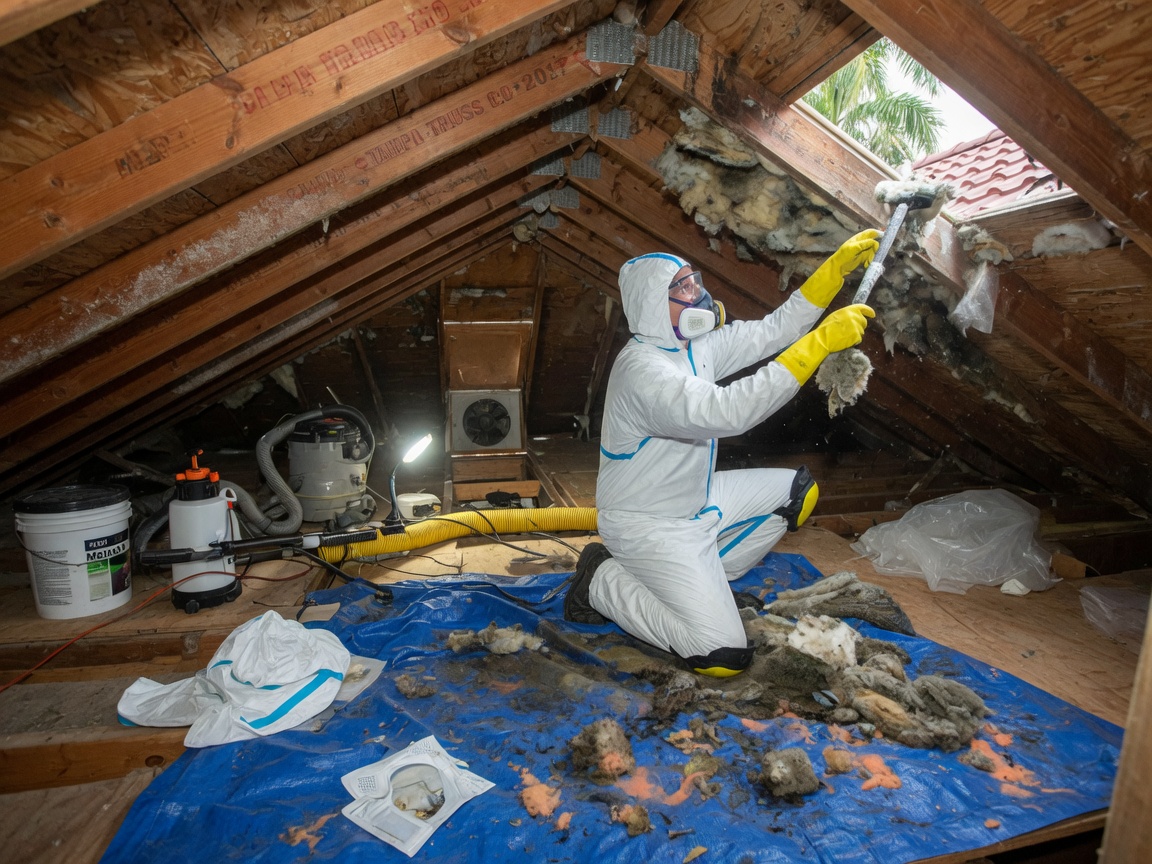
Tampa attics in neighborhoods like Ybor City and Seminole Heights often hold 1950s-1970s fiberglass batts that trap moisture when roof deck temperatures swing during wet summers. Once relative humidity stays above 60 percent for weeks, black mold colonies form on the underside of plywood and along truss plates. Removing the growth requires isolating the space with poly sheeting sealed at every penetration, then HEPA vacuuming and damp wiping rafters before any new insulation goes in.
Davis Islands and South Tampa homes built on fill dirt frequently show roof leaks at plumbing vents or ridge vents after afternoon thunderstorms. When water tracks down the felt paper, it soaks insulation near the eaves and creates hidden colonies that only surface during a whole-house odor complaint. Technicians must pull back insulation in full sections rather than spot treatments, because partial removal leaves spores that re-germinate once humidity climbs again in July and August.
West Tampa and Brandon properties with low-slope additions often lack ridge venting, so moist air from the living space rises and condenses on cooler roof sheathing. This pattern demands negative-air machines exhausting through a window or gable vent to keep pressure from pushing spores into finished rooms below. After removal, crews install additional soffit and ridge vents sized to the attic square footage so the same condensation cycle does not repeat the following summer.
Clearwater and St. Petersburg commuters with homes in Hyde Park sometimes discover mold after installing new HVAC returns that pull attic air. The negative pressure draws humid outside air through soffit gaps, wetting truss bottoms. Remediation includes sealing those gaps with closed-cell spray foam and verifying that bathroom exhaust fans terminate outside rather than into the attic, a common shortcut in older remodels.
Technician insight
In Tampa, the thing that catches most people out with Attic Mold Removal is how quickly wet-summer humidity re-wets rafters in 1950s-1970s homes around Ybor City when the original ridge vent was never installed. Homeowners often replace insulation only to watch the same black spots return within one rainy season because the roof deck never dries out.
Hyde Park Attic After Roof Leak
A homeowner in Hyde Park noticed a musty smell after three days of heavy rain. Inspection found water tracking under felt paper at a plumbing vent, soaking insulation along three rafter bays. Crews removed the wet material, treated the sheathing, added ridge venting, and confirmed clearance before new insulation was installed.
Attic Mold Removal Services We Offer
✓Attic Insulation Removal
Full extraction of contaminated fiberglass or cellulose so new material can be installed without reintroducing spores into living spaces below.
✓Roof Deck Moisture Mapping
Infrared scanning and moisture meter readings along rafters and sheathing to locate hidden wet zones before visible mold appears.
✓Ridge and Soffit Vent Installation
Adding balanced ventilation sized to attic volume to reduce condensation that fuels mold growth during Tampa's wet summers.
✓Bath Exhaust Fan Rerouting
Moving improperly terminated fans so moist air exits through the roof instead of dumping into the attic cavity.
✓Post-Remediation Clearance Testing
Third-party air and surface sampling to confirm spore counts have returned to outdoor baseline levels before insulation replacement.
Attic Mold Removal Cost in Florida
| Service | Typical Range | What Affects It |
|---|---|---|
| Small Attic Mold Removal | $900–$1,600 | Typical for 400-700 sq ft attics in Hyde Park bungalows with light surface growth. |
| Standard Attic Mold Removal | $1,700–$2,800 | Most common range for Seminole Heights and Ybor City homes needing insulation removal. |
| Large Or Multi-Section Attic | $3,000–$4,500 | Davis Islands or South Tampa properties with additions and heavy contamination. |
| Ventilation Upgrade Add-On | $450–$850 | Ridge and soffit vent work performed the same day as remediation. |
Ranges are typical for Florida and confirmed with an exact written quote before any work starts.
How it works
- 1
Initial Attic Assessment
Technician enters through an access panel or gable vent, documents visible growth, measures humidity, and checks for active roof leaks.
- 2
Containment Setup
Plastic sheeting and negative air machines isolate the attic from the rest of the home to prevent spore migration during removal.
- 3
Source Removal
HEPA vacuuming, damp wiping of rafters, and disposal of saturated insulation in sealed bags taken directly to the truck.
- 4
Ventilation Correction
Install or enlarge soffit and ridge vents so moist air no longer pools against the roof deck in humid months.
- 5
Final Clearance
Independent testing confirms spore levels match outdoor air before homeowners re-enter the space or install new insulation.
Pricing
Cost depends on attic size, depth of insulation, and whether roof leaks must be addressed before removal begins.