
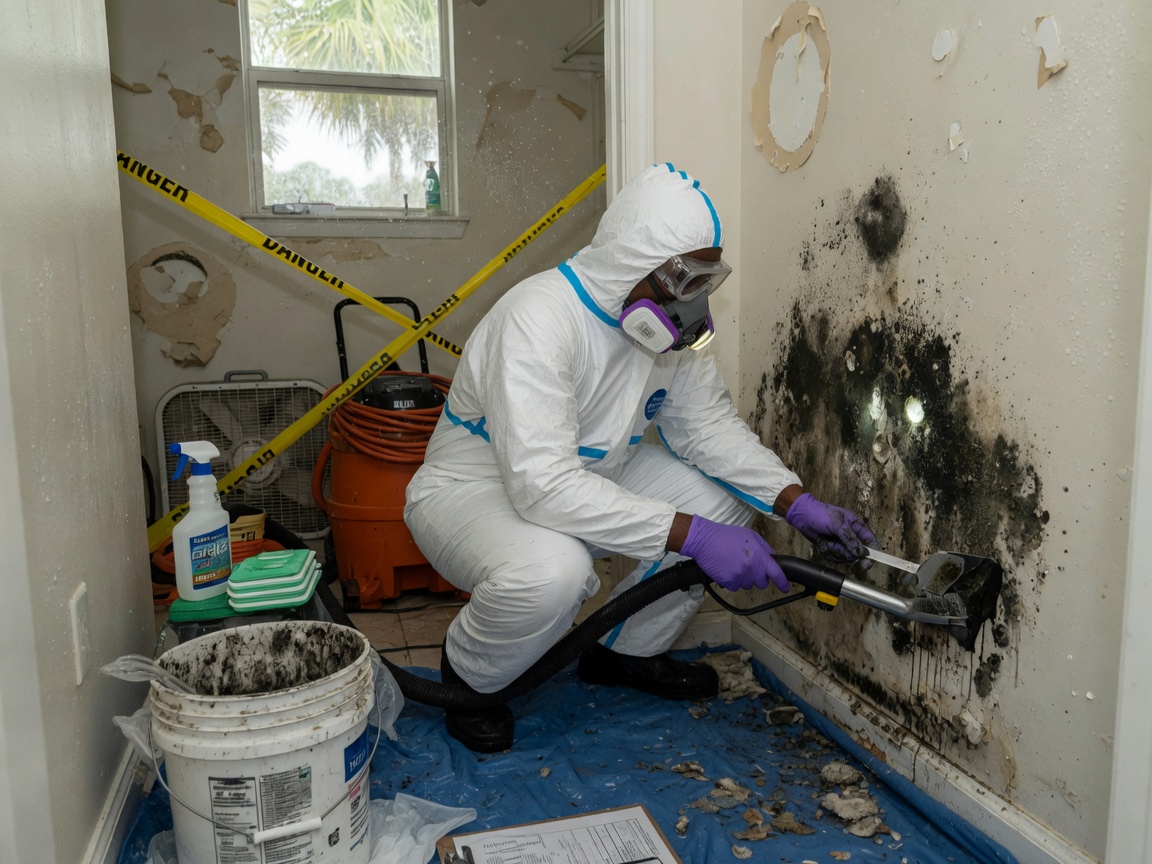
Tampa's humid subtropical climate with heavy summer rains drives moisture into older homes throughout Seminole Heights, Ybor City Historic District, and Hyde Park. Black mold often appears behind plaster walls, under original hardwood floors, and in poorly ventilated crawl spaces common to pre-1960s construction. Remediation crews must account for narrow access points and mixed materials that trap spores, requiring careful demolition and HEPA filtration to avoid spreading contamination to adjacent rooms.
In South Tampa and Davis Islands properties built on reclaimed land, high water tables and occasional tidal influence increase basement and slab-edge moisture. Black mold removal here frequently involves separating affected drywall from intact sections while protecting electrical runs and plumbing that run close to grade. Technicians use negative air machines and antimicrobial rinses rated for porous substrates, then verify clearance with independent testing before reconstruction begins.
Black Mold Removal Near You — Choose Your City
Every city below has its own local Black Mold Removal page with coverage details.
Palm Beach County
Broward County
Orange County
Hillsborough County
Miami-Dade County
Seminole County
Polk County
Broward
Miami-Dade
Lake County
St. Johns County
Clay County
Orange
St. Lucie County
Duval County
Osceola County
Manatee County
Sumter County
Volusia County
Alachua
Leon
Volusia
Flagler
Pasco
Seminole
Brevard
Palm Beach
Lee County
Brevard County
Sarasota County
Martin County
Pasco County
Hernando County
Santa Rosa County
West Tampa and Brandon homes near the river corridor face seasonal flooding that pushes mold into HVAC returns and attic insulation. Removal work must isolate ductwork and replace saturated cellulose without disturbing asbestos-containing materials found in many 1950s-1970s builds. Proper disposal follows Hillsborough County landfill rules, and crews document moisture meter readings at every step to confirm the source has been addressed before final clearance.
Technician insight
In Tampa the thing that catches most people out with black mold removal is hidden growth behind original plaster in Ybor City and Seminole Heights homes where summer humidity keeps subfloor moisture elevated for months after a small leak. Homeowners often stop at visible spots and miss the HVAC return that pulls spores through the whole house.
Hidden Mold After Summer Leak in Hyde Park
A homeowner noticed staining on a bathroom ceiling after heavy rains. Inspection revealed black mold extending into the attic insulation and along HVAC ducts in a 1940s Hyde Park home. Crews contained the space, removed saturated materials, treated framing, and ran dehumidifiers until clearance tests passed, restoring airflow without further spread.
Black Mold Removal Services We Offer
✓Attic Black Mold Removal
Removes mold from insulation and rafters in Tampa attics where poor ventilation meets summer humidity, preventing spread to living spaces below.
✓HVAC System Mold Remediation
Cleans and treats ductwork and coils in older Hillsborough County homes where condensation fosters black mold growth inside the air handler.
✓Crawl Space Mold Treatment
Addresses mold on joists and soil in elevated homes common to South Tampa and Davis Islands, improving airflow and reducing moisture entry.
✓Bathroom and Kitchen Black Mold Removal
Targets tile grout, under-sink cabinets, and drywall in high-moisture rooms where leaks combine with Tampa's wet summers.
✓Basement and Slab Edge Remediation
Handles mold along foundation walls in West Tampa and Brandon properties affected by seasonal groundwater and poor drainage.
Black Mold Removal Cost in Florida
| Service | Typical Range | What Affects It |
|---|---|---|
| Small contained area under 50 sq ft | $600–$1,100 | Higher in tight attics of Seminole Heights homes. |
| HVAC system treatment | $800–$1,600 | Varies with duct access in older Tampa construction. |
| Crawl space remediation | $1,200–$2,400 | Driven by square footage and moisture source correction. |
| Full room removal | $1,500–$3,000 | Includes drywall replacement and clearance testing. |
Ranges are typical for Florida and confirmed with an exact written quote before any work starts.
How it works
- 1
Initial Assessment
Technician inspects affected rooms, checks moisture levels in walls and floors, and identifies hidden growth in Tampa's older construction.
- 2
Containment Setup
Plastic barriers and negative air machines isolate the work zone to keep spores from reaching unaffected areas of the home.
- 3
Removal And Cleaning
Porous materials are removed, surfaces are treated with EPA-registered antimicrobials, and HEPA vacuuming follows.
- 4
Clearance And Drying
Independent testing confirms spore levels, then dehumidifiers run until readings match surrounding unaffected spaces.
Pricing
Cost depends on square footage, accessibility, and whether HVAC or structural repairs are needed.